

Understanding Binaural Beats
What Are Binaural Beats?
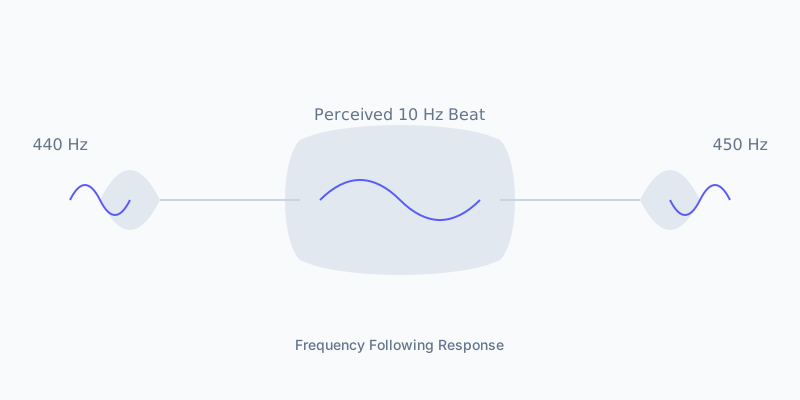
Binaural beats are a fascinating auditory phenomenon that occurs when each ear hears a slightly different tone. Your brain perceives a third frequency, equal to the difference between the two tones. For example, if you play 440 Hz in one ear and 450 Hz in the other, your brain will perceive a 10 Hz binaural beat.
This phenomenon was first discovered in 1839 by Heinrich Wilhelm Dove, but it wasn't until the 1970s that researchers began to understand its potential effects on brain activity and mental states.
Today, binaural beats are widely used for meditation, focus enhancement, and sleep improvement, with growing scientific evidence supporting their effectiveness.
How Binaural Beats Work
The science behind frequency following response and brainwave entrainment
Frequency Generation
Each ear hears its own tone, and your brain perceives a third, pulsing frequency equal to the difference.
Brain Entrainment
Your brain naturally synchronizes with the perceived frequency through frequency following response.
State Change
Your brain waves begin to match the frequency, helping you achieve desired mental states.
Understanding Brainwave Frequencies
Different frequencies for different mental states and goals
Delta Waves (0.5-4 Hz)
Associated with deep sleep and regeneration. Delta waves are the slowest brainwave frequency and are essential for physical healing and immune system function.
- Promotes deep, restorative sleep
- Supports physical healing
- Boosts immune system function
- Reduces cortisol levels
Theta Waves (4-8 Hz)
Associated with deep relaxation, meditation, and creativity. Theta waves are present during light sleep and deep meditation.
- Enhances meditation practice
- Boosts creativity and intuition
- Reduces stress and anxiety
- Improves emotional well-being
Alpha Waves (8-13 Hz)
Associated with relaxed focus and creativity. Alpha waves are present when you're calm, alert, and in a state of relaxed awareness.
- Improves focus and concentration
- Reduces stress and anxiety
- Enhances learning ability
- Promotes relaxation
Beta Waves (13-30 Hz)
Associated with active thinking and concentration. Beta waves are present during normal waking consciousness and focused mental activity.
- Enhances focus and productivity
- Improves problem-solving abilities
- Boosts energy and alertness
- Supports active learning
Gamma Waves (30-100 Hz)
Associated with peak performance and insight. Gamma waves are the fastest brainwave frequency and are linked to higher cognitive functions.
- Enhances cognitive performance
- Improves memory and learning
- Supports peak mental states
- Boosts creativity and insight
Scientific Research & Evidence
What science says about the effectiveness of binaural beats
Clinical Studies
Studies suggest binaural beats may help in several areas, though effects are modest, not every study finds one, and results vary between people:
- Reduced anxiety and stress levels
- Improved sleep quality and duration
- Enhanced focus and concentration
- Better meditation outcomes
Mechanisms of Action
Research has identified several key mechanisms through which binaural beats exert their effects:
- Frequency following response
- Neural entrainment
- Neurotransmitter modulation
- Stress hormone regulation
Key Research Studies
| Study | Year | Outcome | Participants |
|---|---|---|---|
| Fatima et al. | 2026 | Theta beats linked to reduced pain, with possible anxiety and memory benefits (low-certainty evidence) | Meta (13 RCTs, n=630) |
| Elnazer | 2026 | Most trials showed moderate improvements in anxiety, sleep or cognition in young adults | Review (10 trials) |
| Melnichuk et al. | 2025 | Gamma beats improved general attention; EEG confirmed brain entrainment | 80 |
| Kahathuduwa et al. | 2025 | EEG-guided beats rapidly induced relaxed brain states; faster novelty encoding vs sham | 25 |
| Lin et al. | 2024 | Better sleep quality and lower depression in older adults with poor sleep | 64 |
| Basu & Banerjee | 2023 | Moderate positive effects on memory & attention | Meta (15 studies) |
| Miclăuş et al. | 2024 | Reliable anxiety & depression reduction | Review (12 studies) |
| Chockboondee et al. | 2024 | Improved neural markers of cognitive processing | 60 |
| Garcia-Argibay et al. | 2019 | Confirmed cognitive & anxiety improvements | Meta (22 studies) |
| Gantt et al. | 2017 | Reduced physiological & perceived stress in veterans | 74 |
| Colzato et al. | 2017 | Enhanced detail-oriented attentional focus | 36 |
| Beauchene et al. | 2016 | Improved visuospatial memory & brain connectivity | 32 |
| Reedijk et al. | 2013 | Enhanced creativity (divergent thinking) | 24 |
| Padmanabhan et al. | 2005 | Reduced anxiety prior to surgery effectively | Pre-surgery patients |
| Chaieb et al. | 2015 | Influential review of effects on cognition and mood | Review |
Your First Session
Five steps to get a useful first session. The research is encouraging but still developing, so treat it as an experiment: try it, notice how you feel, and adjust.
- 1
Use stereo headphones
The beat only forms when each ear hears its own tone. Speakers won't work, and mono audio mode should be off.
- 2
Pick one goal
Focus, relaxation or sleep. Start with a single goal rather than switching around.
- 3
Keep the volume low
It should sit quietly in the background. Louder is not stronger, and quiet is easier on your hearing.
- 4
Start with 15 to 20 minutes
Short sessions are enough to begin. Shorten them if you feel foggy or restless afterward.
- 5
Notice, then repeat
Jot down how you felt. A short session at the same time on a few days a week lets you judge for yourself.
Not for use while driving, cycling or operating machinery. If you have epilepsy or any seizure condition, check with your doctor first. Binaural beats are not a medical treatment. More detail in our guide to getting the most from binaural beats.
Join the waitlistReady to Experience Binaural Beats?
Start your journey with our AI-powered web-based binaural beat player and custom session designer.